Showing posts with label reviews. Show all posts

Saturday, November 8, 2014

[Review] Harvest Moon: The Lost Valley, Part One - Spring and Summer, Year 1

It requires some work to keep track of why two Harvest Moon games are being released, one without the Harvest Moon title, but which resembles Harvest Moon games most closely (Story of Seasons) and one with the Harvest Moon title, but very dissimilar to normal Harvest Moon (Harvest Moon: The Lost Valley). I am not going to get into that, but essentially what you need to know is that the games carrying the Harvest Moon name in the United States are no longer Harvest Moon games. Here is a fine article that outlines the situation most clearly.

The Lost Valley was just released on November 4th, and I very nearly didn't bother to pre-order it. I ended up doing so the day before it was released, with the facetious reasoning that I really wanted the plushie dog that came with the pre-orders. The game has a heavy Minecraft influence in the art style, which I've never liked, and I wasn't quite sure about it. I've played it quite a bit since it's release, to the extent that I feel comfortable giving this review. I'm going to be following with a lot of negativity before I get to the positivity, so to offset it, I would like to open with this statement: this will not satisfy any Harvest Moon cravings you might have, but judged on its own merits, Harvest Moon: The Lost Valley is a fine game.

Long time Harvest Moon fans will be sorely disappointed by the lack of a town; limited interactions with animals; the odd fact that cows must completely finish eating before you can finally milk them and can't go outside more than once every other day (provided it isn't snowing, which it does, often), since a Harvest Sprite must let them out to graze; crops that may "grow better" in certain seasons, but are not limited to them; an entire year of winter; the end of gift-giving to woo NPCs into friendships or romantic relationships, which takes agency away from the player; an end to the recent gathering craze that's taken over the Harvest Moon franchise since Tale of Two Towns; only three romance options for each gender; and continue.

The Lost Valley is trimmed down to the bare bones. The game is not even 3D, so don't even bother turning it on. You can't customize your character at all, though there you can eventually change outfits-- somehow. The game swears it, but I haven't figured out how yet. Minutes in the game run faster than 1 minute in game per 1 second in real time-- you're even warned about it by one of the Harvest Sprites (now resembling Teletubbies) who says that "time runs fast out in the valley." Above all else, The Lost Valley is a lonely game. If this were a traditional Harvest Moon game, there would be the town, the forest, the mountain peak, and the river area. The Lost Valley takes place entirely in the forest/mountain/river areas, and cuts out the town. You might see merchants when they stop in a couple days a week, and some of the villagers might decide to wander around, but essentially, your character is a crazy mountain hermit who is managing to grow crops in the dead of winter solely by the grace of the Harvest Sprites. There's not much you can really do besides farm.

This is everything that The Lost Valley isn't. So what is the game, exactly?

You begin the game travelling through the mountain pass into the Lost Valley. You are saved from a blizzard by a Harvest Sprite, drawn into a warm cabin with a cozy stove and some cheerful decorations. You begin receiving strange, hazy, prophetic dreams and are soon drawn into a quest to wake the Harvests Goddess and help restore seasons to this place, driven all the while by the urging of sprites, the goddess, and what you see while you sleep. This gives the game a very familiar, fairy tale feel.

You start working the fields. Your only initial company is a single Harvest Sprite and a sketchy merchant, who will sell you things at high prices and buy them at low prices, since the reason he makes the trek to the mountains is because he thinks you're gullible. Slowly, other characters begin to come by. The Harvest Goddess wakes up, and you have to fulfill requirements to get the Crystals that power her bracelet, which controls the seasons. You build friendships with the characters who appear by supplying items for their requests. These items range from flowers of a certain color to lumber to various crops. You'll unlock Spring just in time for it to turn to Summer, which actually means cold, icy winter, again. I imagine I'll unlock Fall just in time for it to turn to Winter, which means I will have to get through an entire season with very little to do until it's finally Spring again.


Due to how pared down the systems are for fishing, growing crops, and caring for animals-- as well as the fact that you have virtually no need to spend money on anything except seeds-- I ended up farming far more than in previous Harvest Moon games. You also end up using the game's Minecraft features a great deal.

By pressing the Y button, you open up a menu which has options from dig, fill, till, shovel snow, fill/dig water path, etc. The entire valley belongs to you, so you can shape the terrain any way you want. You can make lovely raised beds for crops, or create a set of stairs to reach the Harvest Goddess, level most of the mountain to the ground, widen the river, enlarge the falls, etc. Your choice. This is honestly one of the few ways available to you to pass your time. You also have ways of passing skills on through your animals and causing mutations in crops, which are some interesting innovations. The passing on of skills in particular gives you a real incentive to actually breeding your cows instead of just buying more.

Creating different feed requires the windmill, which you must unlock, and fodder recipes, as well as fodder corn so you can make the fodder. Different feed will cause your animals to have different skills, which they can pass on to their offspring. Crops can have different mutations (a Strawberry can produce a White Berry instead), but the cause can be hard to pin down.

This is not a game that really begins the first year, which is something I hate. Games should not make you play 20+ hours to get into the bulk of the content. It's one thing to gain more content over time, but to have so little you can do at the game's start makes the game seem sluggish and boring. The saving grace is that although things unlock slowly, it's a steady pace-- the dreams help you feel like things will happen soon, and the game clock is very quick.

As more merchants are attracted to the valley, you can buy new stock, and different merchants will buy different things from you at a higher rate. If you think about it, Sam, the initial merchant, will buy anything and everything from you, and probably sold them to the people you later attract, such as the florist and restaurant owner. So he bought them from you at a low price. When everyone else in Hillsville (the town you aren't allowed to go to in the game) finds out you exist, they cut out Sam as the middle man and buy your items from you directly at a higher rate. The restaurant owner buys ingredients, the florist buys flowers for bouquets, etc. This system is pretty great in comparison to the "dump everything in the shipping bin, where it will magically disappear into the ether" system of other Harvest Moon games. However, it would have been much better if there was a town and you had to go to different shops to peddle your products, rather than having them hang around your house two days a week to see if you happen to have anything to sell them.

The first season, I unlocked on the very last day of Spring, so I didn't get to see any green at all. The second season, I unlocked on Summer 20, so there are 10 glorious days of summer before I am forced into the bleak winter yet again. As new seasons unlock, more fish are available. New animals come out. Basically, the game starts. The Lost Valley is both incredibly easy, since you have so little you need to do, and difficult, in the sense that you have to work to achieve everything, even if that work is itself easy. A lot of the difficulty is needless, though, like having to wait forever to fulfill a request simply because you MUST talk to the character either in front of your house or at Moon Valley, rather than while they're walking around. And some things simply aren't explained well, like the circumstances of genetic mutation in your crops, which could be one of the neatest features of the game, if it made sense.


Overall, I'm giving this game a tentative thumbs up for the first two seasons/fifteen hours, but I would not pre-order if this game has a successor. Given a choice to go back in time, I'm not entirely certain I would buy it again either. The Lost Valley might provide an introduction to the Harvest Moon series for someone new to it, and with its simplicity and easy nature, it is accessible for younger players. Harvest Moon: The Lost Valley will not satisfy any Harvest Moon cravings you might have, but judged on its own merits, The Lost Valley is a competent and amusing game. For the hardcore gamer, however, it proves uninteresting and a little flat.

Thursday, October 23, 2014

[Review] Fire Emblem: Awakening

Step One: Survey the battlefield. Where are the bottlenecks? Where can you take a stand with a character of high defense so that enemies are only coming at you one at a time? Are there a lot of flying characters? If so, mages with Wind and archers will be helpful. How are your troops laid out? Do you need to make any last minute adjustments to formation? This can be very important because of not only does each troop have individual strengths and weaknesses, but who is going to be paired with whom? Not only can two troops "pair up" and occupy the same square on the map, lending each other strength or defending one another, but there are also bonuses to characters standing adjacent to one another on the battlefield. Not to mention that as characters are paired up and adjacent, their relationships grow, which could lead to marriage and children, who will be recruitable and whose strengths and weaknesses are dependent on who their parents are. Relationships grow better if a paired couple is hit often, since their relationship grows each time they support one another in battle.

Step Two: Constantly reassess the battlefield, the pairings, and volley healers back and forth across the battlefield; due to a limit on how many party members you can have in battle, you'll almost never be able to have two healers out at any given time. High defense is god, but you have to make sure experience is going to the people it needs to go to, not just a high level character, so if you want to use a character as a wall, make sure they have high defense but low attack (e.g. Kellam).

Step Three: Win the battle! Keep in mind that whoever wins the battle gets a large boost in EXP, but make sure you don't win the battle before you've stopped at every locked chest, sparkling spot where there could be extra EXP or an item, and that the right person wins the battle. You okay now? Breathe.

These are the basic steps of getting through a battle in Fire Emblem: Awakening, which is just as stellar (if not more so) than the original GBA Fire Emblem (also known as Rekka no Ken).

Getting through a battle is the easy part, though, if you're doing it right. You also have to keep in mind character builds, side quests, and forced random battles that you can essentially buy for 500 gold, for grinding purposes. These random encounters will generally drop at least one weapon and will always drop bullion (s), which is worth 1000g, thus providing a way to farm gold if you're dedicated. Any given character can be promoted, reclassed, promoted, or reclassed again. The level cap is 20, but you can reclass any number of times, provided you have access to enough Second Seals. Each class offers two skills, and you can customize every character with a total of five. If your characters have gotten married and spawned a time-travelling offspring, that offspring will have inherited some of their parents skills. The child inherits the last skill on each parents skill list. (You can view this as something similar to breeding Pokémon, but I advise against it, because that becomes creepy.)

Other factors: terrain, class weaknesses, enemy strengths and weaknesses, a village that might need to be saved in the map, a recruitable character you might need to get to before they end up dying trying to fight by themselves, Not to mention that for a while, you're going to be worried about which characters are standing near one another, lest they build too much of a relationship and decide to marry, against your specific machinations.

Whew. Still with me?

Fire Emblem: Awakening has an interesting and compelling storyline, endless resources to manage, and varying levels of difficulty that can allow you to cruise through Casual mode or break your throat screaming at Lunatic. With loads of DLC and Spotpass content, it will be a while before you run out of things to do. The game updates certain things based on what day of the month it is, and if you go to bed without buying everything from the merchant, Anna, you might be disappointed to realize it's gone before you wake up. On the bright side, she respawns over night as well.

Yup, that's definitely a pair of sisters.
Eighteen hours in (fourteen on one save-- I started over), I'm on Chapter 8 and have reclassed two characters, Donnel and Sumia. Both are difficult to level. When you first receive them, both can be killed in one turn if you aren't careful. Sumia is a very frail, very junior Pegasus Knight and Donnel is a Villager. I also find Donnel personally irritating, since he speaks in an overexaggerated hick accent. Sumia I managed to level by having her pick enemies off as need be, her quick speed enabling her to overcome the problems of her frailty to level quickly. At higher levels, she hits twice, dodges most hits, and is basically just stellar. She reached level 20 before anyone else, so I reclassed her to Knight, and am currently grinding the last few levels so that she can become a Dark Flier before Chapter 13 (I do not recommend this-- it was a mistake), when her relationship with Chrom will mean that she gives birth to two incredibly powerful children, Lucina and Cynthia. Dark Flier means that she will pass the skill Galeforce on to her children, provided that she gains that skill before that chapter begins.

Donnel was far, far worse than Sumia. On top of getting one-hit killed, his low attack meant that he wouldn't even gain any experience before getting knocked off. His rating with his weapon-of-choice, a lance is E when any other character starts with D at the very least. Finally, I discovered the key: pairing him up with Kellam, a Knight with incredibly high defense that put +6 on Donnel's stats. That meant that Donnel could withstand pretty much any hit successfully, and he's not as irritating when he's chatting about farming with Kellam, who was also raised as a farmer. Once he hit level 15, I immediately reclassed him to Mercenary, one of my favorite classes, and am looking forward to pairing Armsthrift with Leif's Blade and dear old Donny's extremely high Luck stat. He vowed to his mother to return to the village as a hero, and he's currently on the path to becoming-- literally-- a Hero, from one of the worst starting positions I've ever had to deal with. Donny + Kellam = bros for life!

The 3D graphics are beautiful, and the anime cutscenes paired with 3D effect just work. This is one of the few games that actually implement 3D properly. The music score is all right, but the voice acting can get irritating, since the characters will usually only say one word, so you get an endless stream of "huhs" and "reallys" and what have you, so I've found it best to turn off the volume and watch TV or listen to my iPod.

One of the best tactics-based strategy games I've ever played, hands down, and definitely another must-have for the 3DS.

Saturday, October 4, 2014

[Review] Etrian Odyssey IV: Legends of Titan

Long, long ago, I got my 3DS and Etrian Odyssey IV as one of my first games. I had not played it since. I apparently decided to devote... all of today to it. Rather against my will. It's something of a time suck.

I mentioned before how the gameplay was layered and complex, and I was looking forward to playing more. I've now played about eight hours total, and am pleased to say that gameplay remains complex, interesting, and challenging without being overwhelming. My difficulty meter ranges from Dark Souls: Prepare to Die on one end to Kirby's Epic Yarn on the other. Dark Souls had me screaming at the screen about how unfair it was. Kirby's Epic Yarn, meanwhile, is a game where you don't, necessarily, ever have to kill any enemy at all, and can pretty much stroll through any level if you really want to. Etrian Odyssey not too many difficulty levels down from Dark Souls, if you want to get down to it. However, it prevents the "screaming at the screen" difficulty by breaking time into manageable chunks, since the game is bound to an hourly system, as well as being unable to easily recover TP without resting at an inn, which will obviously eat your day away.

Like what?
You have a hub town, Thrasis, where you have an inn, a shop, an explorer's guild where you set up your party, and a pub where you get your quests. Beyond that, the local ruler's court and the wharfs where you can set up communications for multi-player. That's it. That means that there are essentially no characters, and therefore no story. You are plopped down into a fairly difficult world and have no real reason to be there other than your overall directive: explore. So the mechanics of exploring better be pretty damn awesome, right? Thankfully, they are.

EXPLORATION

As an explorer, you main task is making your own maps. Because you're exploring, and no one's mapped this area before. Can I just get a "hell yeah!" for how refreshing that is? You have a blank grid on your bottom screen and numerous tools-- various symbols you can use, different colors, and annotations. This is one of the main time sucks, since you not only are walking through the dungeon, but you're manually mapping out every detail. If you don't, you might find yourself dead.

Nintendo is supposed to be coming out with screenshot
capability for Etrian. Hopefully. Until then, bad iPod pics!
As you're mapping the dungeon, there will be random battles, as well as FOEs. FOEs are visible, wandering monsters that you can see on your map-- one of the very few helpful things the game will give you. The FOEs might chase you for quite some time, or might have specific routes or patterns, depending on how aggressive they are. You can lose them by ducking through a hidden passage or a door, but you can also get caught in a corner, certain death on your left and a wall on your right, trying frantically to figure out what to do so you don't lose all of the maps you've made, the materials you've gathered, and the XP you've gained. This is where Ariadne Thread comes into play-- and you better damn well have at least one on you at all times, or you're screwed. Ariadne Thread will bring you back to Thrasis; Pole Stones will take you to the nearest Geomagnetic Pole (a kind of save spot/fast travel location); Silver Whistles will bring you to the last-used staircase. All three things cost gold, though.

I'm sure you've been in a game where you've accumulated so much gold and you have no idea what to buy, since treasure chests and monster loot will so handily give you whatever you need. Blacksmiths? Why would one ever need to go to one when adventuring can get you what you need? ETRIAN ODYSSEY IV IS NOT THAT GAME. Monsters do not drop gold, weapons, or armor. They drop materials-- legs, hides, etc-- to provide to the blacksmith so she can make you weapons or armor. Which costs additional money, though she does pay some for the materials. You can also sell any food you've gathered from the world map upon re-entering the town. You also need a spare chunk of change at the end of day to give the inn, and if any of your party members have died, you need to revive them at the inn as well, until your Medic learns Revive. Etrian Odyssey is also not a game where you should save everything. Instead, the rule is, "sell everything." Selling unlocks new items, and gives you desperately needed gold.

Mapping becomes its own reward. It's a puzzle, a maze. You need to learn where everything is so you can avoid the dangers, find the hidden areas, and make it back to town alive to collect any reward you've managed to earn. This isn't even getting into the World Map, where there are not only FOEs, but three different levels, boundaries, flying FOEs, tornadoes, material spawn points, other explorers, guarded dungeons....

PARTY BUILDING

I've played a lot of JRPGs. A lot. Just trust me. I've even gone into a soliloquy about the nitty gritty details about how to do it right and how to do it wrong. Never have a played a game that got so many things so right.

You begin the game and are directed to the Explorer's Guild to form your party. When you open the menu, you see the classes you can start with: Landsknecht, Fortress, Nightseeker, Dancer, Sniper, Runemaster, and Medic. This provides you with seven classes and a party-limit of five. Immediately, you have a few choices to make.

Landsknecht is a fairly balanced class, intended for damage. Fortress is heavily-geared to be a tank, and provide a safe place for other characters to hide behind: they have very high defense, and all skills are geared to protecting others. Nightseeker is quick and deadly, relying strongly on status ailments. Dancers are a support class that uses magic through dances that provide effects for 3-4 turns. The last three classes are ranged-- Snipers use bows to bind their opponents; Runemasters use runes to cause elemental damage; Medics heal HP and status ailments. You also have a front row and back row. Each row can fit up to three members of your party.

There are certain stereotypes in JRPGs. Dancers don't do anything useful is one of them. They're weak and frail and why do they even exist? Somehow, though, my Dancer, Mesmer, became one of my most useful party members.

I began the game with a Landsknecht, a Fortress, a Sniper, a Runemaster, and a Medic. This is my standard JRPG lineup. I was forced to switch it up pretty quick, though. Each character begins with three free skill points, and earns one more per level. After getting everyone situated, I still couldn't manage battle flow very well, and tried a couple new combinations before I ended up switching out my Sniper (which is always my name-character) to add a Dancer to the front-line. Yes, the front, not the back, where frail little dancers belong. Dancers actually provide a very good amount of damage, probably about equal the Landsknecht, and though they have fairly low defense, they also can provide numerous status-boosting abilities to the line they're in, which is why I put Mesmer in the front line. She can use a Regen Waltz to allow health to be recovered every turn for several turns, Attack Tango to boost attack, and Counter and Chase Sambas, which allow you to counter when hit or follow up attacks by allies respectively. In between dancing these, she can attack for a decent chunk of damage. She provides support for both my main attackers and my support classes, and stands as a nice bridge between them.

Fortress and Landsknecht are also nicely done. Fortress has numerous skills she can learn to up her defense, cause enemies to attack only her, and or raise the defense of the entire party. Landsknecht has various power boosting skills, but also power breaking skills-- she can shatter the offense of your opponent with her sword. Runemaster and Medic are more linear, skill-wise, with a caveat that TP (technical points, similar to magicka or magic points) has to be very closely managed. This incentivizes either developing some kind of physical skill or extending TP in some way.

You can gain a skill level every time your level is raised, and there are various skill trees that you can follow. You can also later subclass characters. For example, I can either subclass my Dancer with a combat-oriented class to make her combat skills keener, or I can supplement her skills with a Medic subclass and get rid of my Medic, replacing the Medic with another fighter. This, of course, would mean that my Dancer wouldn't often have much opportunity to show off her fighting skills. Replacing her with another fighter would also likely mean I would have to switch her to the back line instead of the front line, which could be problematic, since she deals a fair amount of the party's damage.

(Some initial thoughts are:
Fortress --> Medic
Dancer --> Nightseeker??
Landsknecht --> Imperial or Bushi
Runemaster --> Imperial
Nightseeker --> Arcanist  or vice versa)

These are the two main game mechanics: party building and exploration. This is quite enough to take up hours of your time, considering how well-done both elements are. The game is difficult, but very satisfying and has a lot of depth. The only downside that some might find with this game is the lack of story, which hasn't so far bothered me overmuch, since it means you can easily delve back into the game. The other potential downside is what I consider a plus: highly difficult, the game punishes as much as it rewards. With numerous resources to manage, complex parties and classes, stellar dungeon mapping, and exploration, this is definitely a must-have for the 3DS!

Friday, August 29, 2014

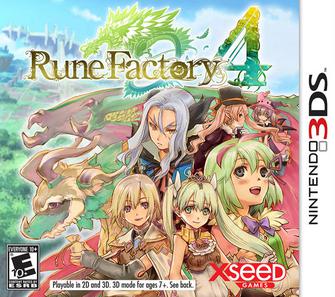
[Review] Rune Factory 4

My Harvest Moon/Rune Factory collection, as of 8/30/14
In the beginning, there was Legend of the Dragoon. It and Pokémon Red were the first games I played. I also played Final Fantasy and Dragon Warriors IV to absolutely no end, but those came later, with NES emulation, though we did have the actual NES Final Fantasy as well. Around the time where I was beating the pants off of Dragon Warriors IV, I also began looking into Harvest Moon.

I was utterly confused. The original Harvest Moon plops you down in a town with little to no explanation, leaving you to wonder what you're supposed to do, where you're supposed to go, and how you're supposed to do this farming thing anyway? It was not for me, not at age ten.

But after I got a Playstation 2, I also got Harvest Moon: Save the Homeland, and I tried again. Harvest Moon: Save the Homeland is a somewhat reduced version of the other games in the Harvest Moon series.

In it, you are given a very small farm, told your objective (save the homeland, since it's about to be wrecked by developers) and given several questlines where you can accomplish it. This all required only a year's worth of in-game play. In my first play through, I did not save the homeland. The homeland was given a game-over, try again, ending, leading to the determination that allowed me to go through every single one of those several questlines and save the homeland over and over and over. I loved that game and those characters, but in searching the internet to figure out what I had to accomplish for certain endings, I realized that in Save the Homeland you couldn't marry any of those vibrant, thoughtful, interesting characters that you helped save the town in the game-- and essentially, save the world, since that entire game was that town. And you were helping them; they weren't helping you, a fact I appreciate now, since the world was saved by every girl who would have been a bachelorette in another Harvest Moon game. Regardless, this realization that Save the Homeland was an abbreviated version of the rest of the series led me to collecting as many Harvest Moon games as possible. New Harvest Moon games are an instant pre-order for me, no ifs, ands, or buts.

I've missed a few, due to not currently having the system, like Hero of Leaf Valley, the remake of Save the Homeland that added back in the features removed from the original, made for PSP. I am still trying to find a good price on it, so if you know, tell me! I've called GameStops almost two hours away to try to find it, so trust me when I say I'm serious.

I did not play the first three Rune Factory games, though. Rune Factory and Innocent Life were two games put out as spin-offs of Harvest Moon in 2006. Rune Factory was a fantasy Harvest Moon; Innocent Life was a sci fi Harvest Moon. Rune Factory took off and Innocent Life did not. I wasn't much interested in either. I prefer my Harvest Moon straight up. However, so much hubbub has happened over Rune Factory 4 that I decided to pick it up, and since they finally allow you to change your gender, I decided that it was definitely the one, over the older games.

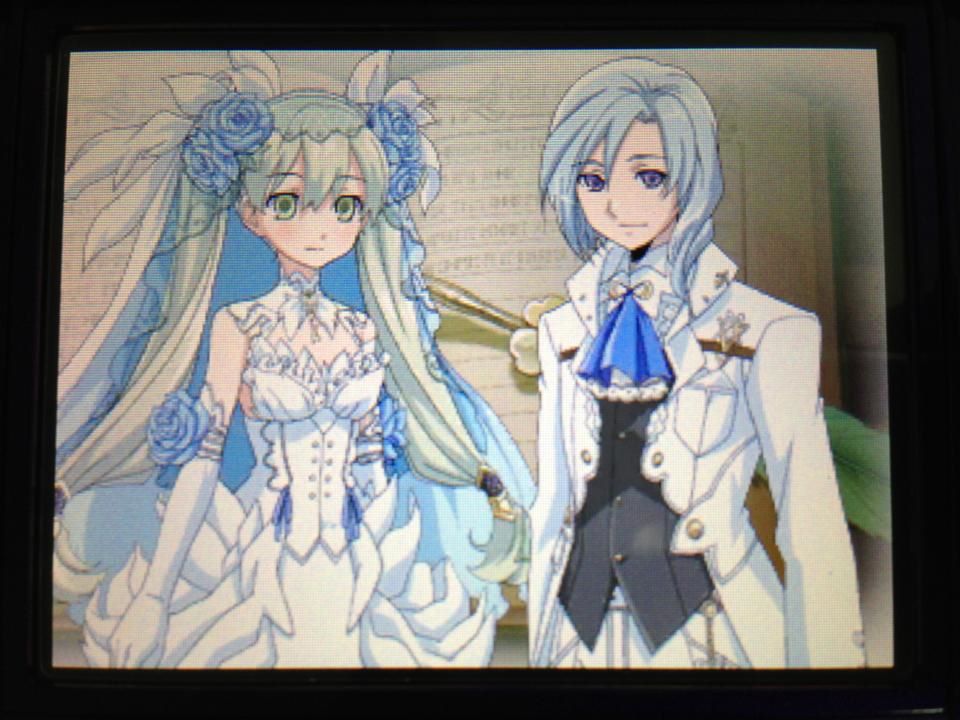
Rune Factory 4 begins when your character comes tumbling down from an airship and lands on a dragon. Each character is well and fully imagined. More frequent cut scenes allow more character building to occur than in any Harvest Moon game. There are often radiant events that show the characters are having interactions with each other, not just you. They talk to each other in groups, with speech bubbles appearing over their heads. They sweep or cook or eat when its time. Each shop is run by the owner and a helper, who trade off working, so that it actually seems that everyone in the game is doing a job-- finally! In Harvest Moon, it often seems like everyone is wandering around without purpose. Not so in Rune Factory, where the stores are obviously running and the town guard is obviously guarding.

Festivals are incredible, too. Everyone has dialogue about it, getting psyched up the day before, or maybe asking for help finding something to help them in the contest. The festivals are numerous, and only appear when you-- as the prince or princess, which is a conceit particular to this Rune Factory game-- announce one by royal decree. The characters also talk about each other's birthdays. They get each other gifts, and then sometimes talk about it the next day. Some of the radiant events you see are built up over the course of days, with rumors and all the characters talking about it. It is a wonderful system that I wish was implemented in the normal Harvest Moon.

Now we get into how Rune Factory 4 is similar to but quite different from the Harvest Moon series as it currently stands. Farming is most similar to the earliest of the Harvest Moon games. You have a field which is full of rubbish and must be repeatedly cleared, not like the two by four squares which never became overgrown by weeds in Harvest Moon: A New Beginning. You have a limited number of crops. After completing a certain quest, "Ship a Level 2 Turnip!" stores will begin carrying the highest level crop you've shipped, so you can raise the level of the crops all the way to 10 from 1. This can be done in various ways, one of which is a fertilizer bin where you put weeds-- another feature I wish the regular series had. Crops can spontaneously drop seeds, or you can harvest them with a sickle, which causes seeds to drop but the crop to be destroyed. (Also a thing I want in regular Harvest Moon.) You can also befriend monsters to live in the monster barn on your farm, where they might help on the farm, drop items like wool or milk, or work helping with the crops.

Crafting is a major part of Rune Factory 4. You have a forge, various cooking stations, a chemistry lab, etc. You can make your own weapons, medicines, and food through recipes you can learn through recipe bread you've bought from the owner of the local restaurant, Porcoline. This means that you have to keep virtually everything you find, which means the inventory system can be hard to manage unless you're very, very careful, and you might end up selling or using a higher level seed, for instance, than you actually meant to. All of these activities are linked to skills that level as you use them. Your storage trunk will end up full of various stones, gems, sticks, monster drops, herbs, weapons, shields, and potions. Your fridge will be full of raw food materials and cooked dishes, which you can't always justify shipping, since you need to regain health and rune points (essentially health and stamina/magic) while you quest or after doing a lot of crafting.

Doug and Dylas pretend they hate each other, but are actually very close.
The game is divided into the main quest line, which involves the questing and dungeons, and complementary questlines, involving romance, farming/crafting, and festivals. Essentially, town life and dungeon crawling. Dungeons and new areas unlock as you complete previous dungeons and participate in town life. The dungeons are the main quest line, following a story arc that involves the god-dragon Ventuswill and a line of monsters that are mysteriously turning into humans after you battle them, complete with memory loss. You yourself have memory loss after falling from the airship at the beginning of the game. There is a lot to do, but none of it really takes very long to do each day. The days are fast paced. I generally begin each day by spending a couple of hours on the farm, then a few more talking to everyone in town before I select a companion and go questing with them. This is another awesome feature of Rune Factory that I wish could be implemented in Harvest Moon, though I understand why it can't be. You can choose one or more of your friends or romantic interests to go questing with you, fighting monsters and helping out by telling you about treasures. You can become quite attached to them after they spend almost all day in-game with you. They level as they journey with you, as well, and you can upgrade their equipment. You can also choose one of your monsters as a mount or just to go along with you (this has a mini-story sequence that is one of the radiant events). In Harvest Moon, there's no real reason for anyone to journey with you, since there aren't quests. The only way this could be implemented would be if you asked someone to go to a market with you, if a game included more than one town or a caravan feature, or if mines more closely resembled dungeons. After questing, I head back home, up my RP again if needed, and do crafting or fishing.

Currently trying to decide between Vishnal and Arthur as a romantic interest.
Though Rune Factory 4 is entertaining and fun, and I especially appreciate the little details regarding villager interaction, it is essentially both RPG-lite and Harvest Moon-lite. None of the features really go into depth because there are so many of them that you can't devote much time to them. Caring for crops and monsters takes all of two seconds. Questing and finding new areas is essentially a Diablo or Zelda-esque time fighting through monsters, saving, teleporting, and then being done for the day, with little extra work involved. This means that everything falls into a routine, making it really seem like this is what everyday life in a fantasy village would involve.

Rune Factory 4 is a genuinely good game. It is polished, practiced, and accomplishes everything it seeks to accomplish. It avoids the grind of the Harvest Moon series, which can be a bummer if you like the grind, but with so much else to do, it softens your regret. The detail to character is amazing and the voice acting is just enough to help without overpowering (a shout out to Edward Elric's voice actor, Vic Mignogna, who is also voice actor to Vishnal.) You will grow to genuinely care about these characters and the story, even if it is a touch simplistic. Overall, a solid 3.5 of 5. That being said, the Harvest Moon series contains better gameplay; Rune Factory has more compelling characters. Harvest Moon is full of micromanaging, statistics, and the day to day running of a farm. The gameplay of Rune Factory 4 is mostly concerned with easily completed tasks, supported on a framework of interesting characters and radiant cutscenes. The weak gameplay keeps a good game from becoming great.

And as a post-script, Happy Anniversary, Virtual Obsessions! This is my 100th post, almost 4 years in, putting me at an average of 2 posts a month. :)

Friday, November 22, 2013

[Review] Animal Crossing: New Leaf

There is definitely a sense of pacing to Animal Crossing: New Leaf. New Leaf is my first Animal Crossing, so some or all of this might apply to the other games. Sweeping declaration: Animal Crossing has a better rhythm than an rhythm game ever could.

Since it's bound to real time, the player is forced to integrate the game into their everyday life. Your flowers have to be watered every day or so, or they'll wither and die. Your friends in game want to talk to you. There are fossils, bugs, and fish to find. Stores will expand and evolve, and their stock changes day to day. Completing these tasks and visiting these things doesn't take long, but you do have to time them correctly. Most stores don't open until 10 and can close anywhere between 7 and 11. If you have to work IRL, you might not have the time to complete everything at once. For example, I work about 2 to 10. Shops are closed by the time I get home, normally, and earlier in the day I have sleep and chores to worry about. So breakfast IRL tends to involve a quick jaunt up to Main Street in Animal Crossing. I water the flowers and pick the fruit that I can, drop it off at the Re-Tail store for bells (money), and pray I'm home at night in time to sell the rest to the store. Then I have to water more flowers, dig up the fossils, and maybe work in a little fishing while watching TV after work or eating my regular much-belated dinner. (The schedule is the same but reversed if you get up before the stores open, btw.)

I suppose the question is, why bother? What reward do you get for playing Animal Crossing. There's no real story to speak of, no monsters to slay, no bosses to loot.

Exploration, customization, accumulation, and socialization.

Exploration: the world is small, just your little village, bu tit changes. The stores can change, the villagers change, the flora and fauna changes. There are various events that take place

Customization: you can customize your house, the layout of your village, handpick the villagers in your villgae, and customize your own character with clothes, accessories, hairstyles, and tools. You can change the villagers' catch phrases and greetings, and send them furniture and cltothing that they might decide to use.

Accumulation: endless furnitures, wallpapers, carpets, house exteriors and expansions. Getting the villagers you want to live in your town, fully expanding the store fronts, building all the optional buildings, gathering all of the fish, bus, fossils, cross-breeding the flowers to get new color strains.

Socialization: the 3DS makes it easy for friends connected wirelessly, not to mention SpotPass. You can glare lustfully at the houses of other players after you've SpotPassed them, And so many people play it thatyou can gloat about your latest find with ease.

Richard Bartle wrote in his seminal essay "Hearts, Clubs, Diamonds, Spades: Players who Suit MUDs" that there are four types of players: Achievers, Explorers, Socializers, and Killers. If you count the Killers as the more negative aspects of socializing, such as one-upsmanship, Animal Crossing has enough in it to satisfy these four main types of players.

On top of all this, the 3D graphics are beautifully implemented throughout the entire game. No one has the 3D utilized nearly as well.

Animal Crossing is amazing especially as something to fill moments between other games and activities due to its low time commitment. Lunch breaks, bus trips, and bored moments with family-- these are all ideal times to spend a few seconds watering flowers, checking a store's stock, or rearranging furniture.

4/5

Monday, May 27, 2013

[Review] Evoland

We all know that I started out my career as a gamer with a big ol' helping of JRPG adoration, right? Right? Right. Evoland, a small indie RPG available through Steam, is a trip back in JRPG video game history, with all of its pitfalls and glories. As you work your way through the game, you unlock developments in gaming history. Evoland started as a concept game, and it plays very much like one, but that doesn't make it any less enjoyable.
 Your first two unlocks are the ability to move right, then left, and then scrolling, better scrolling, etc. You gain color (16-bit, then 256-bit), eventually move onto 3D, get HD, all the while moving through the gameplay styles of Zelda and Final Fantasy, with a little bit of Dragon Warriors thrown in there for good measure. Ye classic card game mini game is available-- always a good, if occasionally tedious time-- and. Well. Let's put it this way. Your name is Clink. Your companion's name is Kaeris. You have Claud's sword. Kaeris' uncle is named Sid. Let me unpack that for you, just in case you aren't a giant dork. Cloud/Link. Kairi/Aeris. Claud = Cloud. Sid = Cid. Let me unpack that further. Final Fantasy VII, Zelda, Kingdom Hearts, Final Fantasy VII again and again, and all of the Final Fantasy series in general with Cid. And yes, Sid does have an airship.

The game is also in many ways a testament to all kinds of geekery, with references to Skyrim, like the one on the left, and even a reference to Terry Pratchett's A'Tuin, the World Turtle, as pictured below. The storyline is thin, the monsters are few, and the game only really ventures from JRPGs with a Diablo-style segment toward the end. If it had really wanted to begin with RPGs at the very beginning, it would have started with Adventure, but it didn't, thus placing its focus firmly on JRPGs. It also limits its focus pretty narrowly on The Legend of Zelda and Final Fantasy VII.

It's a very short game. I wouldn't say it was worth the ten dollars I paid for it, so I suggest you grab it on sale. But it is definitely worth buying in general for a very interesting game, a great concept piece, and a fun time playing "spot the reference." I feel that it did lack some focus. It didn't actually follow all RPG history, and if it was only going to follow JRPG history, it shouldn't have included Diablo, unless it was going to use that as a stepping stone for something resembling Dark Souls. The game was too short to include all that, though, so it ended up feeling a bit out of place. I would feel a bit better if it had started with Adventure references, honestly. The game was made in a rush, and it's obvious that they didn't have any time to do any research, so they just used whatever came to mind. However, in polishing the game up, they should have tried to do a bit more than they did. It still works, but it could have been a smoother journey.


Friday, November 9, 2012

JRPG Party-Based Combat

About two or three months ago, I had been playing a lot of Dragon Quest V: Hand of the Heavenly Bride. I'm a firm believer in handhelds, thus why I love my DS so much. Handhelds allow focus to be on gameplay rather than graphics, which is something that I value highly. Dragon Quest V sent me on a kind of retro journey into adoration. I've long preferred the Dragon Quest series to Final Fantasy because I like the gameplay and the stories better. I find the monsters charming; I adore Slime.

There are a lot of things I love about Dragon Quest V. The little things that count can be counted upon in this game. The Hero, who has extremely bad luck in game, has a very, very low Luck stat. The inn prices-- in Whealbrook, post-burning, the inn price is extremely cheap, due to no one wanting to stay in the town and the innkeeper needing to take what she can get. In Coburg, where the taxes are high, the inn is about eight times more expensive than in Whealbrook. You can actually talk to your party members. One thing I don't like is the combat system.

JRPG battle is almost always turn-based. It is always party-based. In the combat menu, selections are divided up into different types of combat. Usually, the rule is Attack (physical), Magic (either assault or supportive), Item (to access your inventory), and Flee (to flee battle). Different characters will have different abilities. Some will be powerful magic users, either combat or restorative, and some will be tanks (high attack, defense, or both). However, different variations can turn combat in a JRPG from a button-mashing mess into a fun time. I've broken it down into the two major things:

1) Lineup. Standard JRPG lineup is just who goes first-- one, two, three, four. Enemies tend to focus on the ones in the middle in my experience, for whatever reason. However, good JRPG lineup also has front and back positions that the characters can take. If a character is in a "back" position, their physical attacks are weaker, but enemies' attacks will hurt them less. That means that the back position is good for archers and those who are primarily magic-users. Ideally, this also means there are archers.

Why DQV Failed: They didn't include this, simple as that, even though there was distance weaponry (boomerangs) and magic.

2) Unbalanced party members to make up a balanced party. Yes, this makes sense. Just hear me out. Each character should have strengths and weaknesses. And they should be important and their weaknesses should be fatal if they aren't supplemented with other members of the party. This is why a JRPG is a party-based RPG. If the party itself doesn't matter, why do I need to have one? Why don't I just dump everyone off somewhere and journey alone. The hero always needs to be relatively balanced, since for at least some of his journey, he will be alone and need to fight alone. However, he will be fighting against groups of enemies and thus will be outnumbered. He needs his party. His party should also need him, and each other. If each member of the party is perfectly balanced, why bother? Having unbalanced party members (Stat-wise. Not mentally. Though that would be cool.) gives the player a resource to manage. That way, you need to figure out which party mix-up would work best in various situations, in addition to figuring out which attack to use.

Why DQV Failed: For many, many hours in the game, it's just you, the balanced hero, Harry, the balanced prince sidekick, and whatever monsters you recruit. Dragon Quest V could have done something awesome with this, since recruiting monsters gives you a gigantic party to work with, each (presumably) with different strengths and weaknesses.

Of course, given where my brain has been recently, I related this to MMOs. MMOs are, by nature, party-based, though some obviously emphasize PvP rather than cooperative play. One of the reasons I like Korean MMORPGs is actually because there is very little cooperative play, so I don't have to deal with other players if I don't want to.

Relating this to Elder Scrolls Online, how will a game famous for their single-player games, where you can be anything and need to be able to journey alone, manage party-based combat? Will even a fighter still be able to learn restorative magic? How will Elder Scrolls Online walk that line between self-sufficiency and cooperation? How will they deal with the hero mentality of their long-time fans and the MMO world's need to have a little army? As DQV shows, you can't really have both. To wait and see is the only thing I can think of to do, and even then, it bothers me. Because unless some friends decide to jump on the Elder Scrolls Online boat, I don't want to play with other people, necessarily. And I don't think the game will be a success as an MMO unless it makes parties a necessity.

Oh well. If Elder Scrolls Online fails, I can always immerse myself in Skyrim again. There's always that.

Tuesday, December 27, 2011

[Review] The Sims 3: World Adventures and Ambitions

As always, Xmas yields a bevy of new games: Darkspore, as well as The Sims 3: World Adventures and Ambitions. The two expansion packs also coincided with me finally getting the right updates/patches, so who even knows what was included in the games and what was included in the patches. @_@

The breast/muscle definition slider was interesting for the various feminist reasons always given for why breasts/muscles aren't a direct correlation to one another in terms of attractiveness. This was definitely part of the patch/update, as it was released with Late Night. The feminist argument why this isn't a direct correlation is that muscles are indicative of strength; big boobs are indicative of nothing and are cosmetic. However, I approve of the ability to have different body shapes. The fact remains that some people have larger breasts than others, which is why this argument can be discounted, in this particular case. Where game covers have scantily clad, big-breasted women-- that is objectification. Where a game includes the ability to make different body shapes, that's a different case entirely.

The patch also added in the scrapbook function, meaning essentially, memories are back. The notifications for it must be turned off immediately, as the constant popups interfere with gameplay. They still have yet to bring back the ability to write a story with screenshots and captions, which completely obliterates my enjoyment of The Sims 3 vs The Sims 2. *sigh*

World Adventures

World Adventures allows a Sim to go to another country, perform adventures (quests) and gain points on their visa. It quickly becomes tiresome. Sims occasionally have adventure-related wants (especially if they have the Adventurous trait), but the idea of filling a Lifetime Want that's adventure-related is boring and would entail little more than grinding. However, the new items and clothing released with this was nice, as well as the 1000 Sim Points that come with the expansion. The eyeliner that is available is also very nice, but there's a bug-- which no one has yet fixed-- where the eyeliner disappears for no reason, as if it doesn't exist. Thus, although I saw it once, now, no longer. Problem! It shares similarities with The Sims Medieval and The Sims: Vacation/The Sims 2: Bon Voyage expansion packs. It managed to make the vacations somewhat more interesting-- they were always some of the most boring expansion packs-- but vacations aren't interesting enough for Sims to have Lifetime Wants for them. Used as what it is-- a vacation-- having the adventures blended with the vacation is interesting. It's also nice how going to different countries is integrated with career opportunities.

Overall Rating: 2.5/5. It's an okay addition, but nothing special.

Ambitions

Ambitions is quite a bit nicer, with new buildings, laundry, and lots of functionality. I especially wanted this for the Professions-- different than careers-- where you can be a ghost hunter, private investigator, stylist, etc. That you can be self-employed now is very nice. Tattoos were released with this expansion pack, but I'm fairly certain that patches gave them to me beforehand. Either way, there are tattoo stations now and lots of downloads available for nicer body art than the game provides. The new hairstyles are very nice.

Overall Rating: 4/5. This expansion pack enriches roleplay experience in many ways.

Monday, October 31, 2011

[Review] Fable III for PC, Part Two

A while ago, I posted my original review for Fable III. Until now, I haven't had a chance to fulfill my promise of giving it another go and seeing whether my opinion of it changed. Since I upgraded to my new computer, however, I've had a chance to play again, starting afresh since I had some issues transferring my save game files.

First, for clarity on the "Fable 3 Main Executable Error" which has been plaguing people with few answers for a while now, if updating Windows Live doesn't help-- and it does help some people, apparently-- your graphics card might be too weak. This was my problem-- using Can You Run It? might help you figure out if this is the issue. For a run-through of computers I've played it on:
  • Nvidia GeForce 9800M runs Fable III perfectly at Very High.
  • ATI Radeon x1300Pro cannot run Fable III at all and resulted in a Main Executable Error.
  • ATI Radeon 4200 HD runs Fable III at Very Low, with significant stuttering. The graphic interface is so affected that playing the mini games successfully is impossible, as well as battles where you have to keep moving and dodging (e.g. boss battles like Saker).
  • Nvidia GeForce GTX 260 runs Fable III perfectly at Very High.
On to the updated review. I'm using female pronouns for the player character, since I played her as female and skirting pronouns eventually becomes problematic.


Roleplaying Capability

Morality


The patterning on her face is due to Good morality.
In trying to roleplay a bandit princess, as I also attempted to do before the issues with transferring my saved game, I again failed and have a very high morality. As I stated before, it's occasionally rather unclear why one choice is good and the other is evil. To use the example of the playwright quest again, why is it evil for me to deviate from the script? My motivations aren't evil, and the reason that people still perform plays are because they can be unique, with different twists on different roles. It's evil to have a mind of your own?

If the player wants to play an evil character, they have to make evil decisions all the way through, regardless of whether they think a choice is evil or not, and regardless of whether it fits with who they're roleplaying. There are no room for murky morality questions, where a player could have good reasons for doing a bad thing, or even just greedy reasons for doing a bad thing: there are only things decided by the all-powerful Lionhead gods to be good and evil, sometimes for no apparent reason and sometimes just to murder chickens. An example of murky morality or greediness in Fable: The Lost Chapters would be virtually all of the quests one could do to raise money for Teresa's present. The player could take the cheating husband's bribe, but still tell his wife, or could beat up the "good" little kid, but still beat up the bully and give the bear to the little girl, etc. The lack of any grayness to the morality in Fable III makes for a flat experience when trying to play a character who's just a little morally questionable rather than out-and-out murdering, chicken-torturing evil. It also means there are no places where the player could make up a turning point in their roleplay: I wanted a character who was basically good to be changed and become evil due to the death of her beloved. So I made good decisions. When I wanted to make bad ones, the ones available were too bad to ease from one moral path to the other and still keep roleplay characterization.

Tattoos glow blue due to Will use and morality.
This is all additionally problematic due to the storyline. The player's purpose is for their character to be the good ruler compared to King Logan, the evil ruler. This means that the entire story is propelling the player to be good, regardless of what they want, and the story until the Princess becomes the monarch is all about making people like her so that they support the bid for the monarchy. If the player wants to roleplay a perfectly good, all the time, character, Fable III is excellent for it.


Relationships

For the first time, ever, a lesbian! It only took twelve hours. For every five gay men, one lesbian.
I doubt that anyone will disagree with me if I state that the Fable series has the stupidest system for forging emotional connections yet seen in games. This doesn't even just apply to relationships, but also, haggling: to haggle, I would have the Princess dance a few times with the shopkeep. A few rounds of dancing and hero posing will make everyone fall in love with her, and then begins a plague of Relationship Quests, which usually involve fetching and carrying for no apparent reason. This would be a fine enough idea if it was harder to accidentally set off a quest and if the quests were all unique, and developed individual character personalities somewhat. As it stands, one character is much the same as the other, and there are times when I can barely keep myself from shooting them when one of them tells me, "Why don't you do something bad for a change?

"Oh, if only you realized," I think, resisting the urge to turn off the safety and take aim.

Rating: 2/5. It would be lower, given the inability to affect the Hero's morality or form any complex relationships with other characters, but after playing Oblivion I've come to appreciate having different choices in armor/clothing and weapons. Customization is, as the game masters in The Game quest say, key.


Battle


This is where I would give the highest rating hike between the first Fable III review I did and this one. Magic in Fable III is much more limited and has fewer options than it did in Fable: The Lost Chapters. However, what one can do with it can be interesting in its own ways. Slow Time and Summon Creatures are both potions rather than spells, and all that's left now are attack spells in the form of gauntlets-- nothing available to make me/the Princess invisible, move faster, etc. This is a weakness in that I often wish I could cast spells on myself in some way, and am frustrated by the lack-- most RPGs allow spellcasters spells they can cast on themselves.  Despite this, spellweaving allows attack spells to be used together is very interesting-- I like to combine the Shock and Vortex spells to make what I call the "insta-win" spell. Essentially, it brews up a thunderstorm that can toss entire parties of enemies around as well as paralyze them.

My naming scheme: angry women warriors with wings.
As the player character moves up levels in melee and ranged combat, various customizations to the weapons occur based on gameplay. For example, if you're charitable, murderous, or treasure-mad, all of these things can affect the appearance of the Hero Weapons. This is a nice way to make a completely customized weapon, perfectly suited for the way the game has been played up to that point. Legendary weapons, which can be bought or found, have a preset appearance that changes as individual features at the same time as the Hero Weapons. They have unlockable bonuses that enable them to become more powerful, and which provide sort of mini quests for the player. Killing 300 humans, having an orgy, digging things up... these are all ways to upgrade Legendary Weapons.

Another nice touch is the Princess' finesse with her sword-- the animation and the way she moves and parries shows real skill, which is a pleasure to watch. Most RPGs are just slashhackslash, so it's nice to see a game where the character actually looks like she knows how to use her weapon as something other than a baseball bat.

Once the player progresses past the starter area where there are only wolves, there are lots of Hobbes and Hollow Men. This can get very tedious and some variety would be welcome, but at least it's no longer far too easy. And eventually, the wolf packs gain Balverine leaders! Lack of difficulty was one of the larger faults of the game, so it's very nice that it picks up after that. As my Princess leveled up, groups of enemies also began to get harder. The Mercenaries start to wear armor and have Will users, the Hobbes have their equivalents of the same, the Hollow Men have their equivalents, &c. The only flaw in this is that the hardest of each group looks like a previous boss. For example, the hardest Mercenary unit to beat looks and acts precisely like Saker. So, until I saw the unit more than once, I was terrified I had somehow managed to accidentally kill Saker himself and would lose his help in gaining the throne.

The other large fault with battle remains, however: no will points, no hit points, and since games are essentially a system of rules to manage various resources (e.g. points) with, this is a problem. I think I've only had to use potions once so far, in the battle with Saker. I feel less like I'm fighting for my life and more like I'm having a mix of target practice with my gun and tornado fun-times with my magic.

Revised Rating: 3/5. There are many flaws, but even with them, combat is still enjoyable.


Quests

What are these people smoking? And can I get them some more?
The early quests (first ten hours) are watered-down versions of those that appeared already in Fable: The Lost Chapters, and they are still boring. However, the main line of quests is fairly solid, especially in comparison with the cripplingly weak side quests. Once Reaver entered, I was intensely pleased by how incredible he is and instantly wished I was him. It also made me want Fable II even more than I did before. (Dear Fable IV: I would like to become Reaver.)

Reaver is my hero. Can marrying him be a new DLC?
Everything gets better once the main quest moves on to Bowerstone. The side quests are more interesting, though still much the same thing: escort X to Y, in general. The Game is hilarious, as are the ghost quests in Mourningwood with the Lovecraft jokes. The Silverpines Curse is... actually heartbreaking in some ways, but possibly only if you love dogs a great deal. It is a little disappointing that the Sunset House, despite being so creepy, culminates in chess. It does make a great mini game, since it has just the right level of creepy to make it interesting, but it doesn't work as the end of a quest. Halloween might be affecting my mood here, however. The Game reminds me of Terry Pratchett, and thus makes me intensely pleased, even though not much really went on in it besides listening to voice overs while I cracked up every five seconds.

Revised Rating: 2.5/5. Early quests are largely, though not always, awful and uninspired. Deal with it. Side quests tend to fall into the same patterns.


In Comparison to Fable: The Lost Chapters

Demon Doors

I don't think that it's that there's fewer of them. I think the problem is that none of them can be opened until the player progresses at least fifteen hours into the game, probably more. This is made up for somewhat by the silver key chests and the gold key doors, but instead of gold key doors, I would honestly prefer just a few Demon Doors with quests that are easier to accomplish.

Everything Else

See the first review if you desire the incensed answer to this. Let's just say, almost everything about Fable: The Lost Chapters was better and leave it at that.


Overall Rating

Story: 4/5
Battle: 3/5
Quests: 2.5/5
Roleplaying Capability: 2/5

Final Score: 2.9/5

Fable III is an average game, verging very close to being a bad game and often slipping over that fine line. However, nostalgia for the original Fable, love of the ability to customize your weapons and outfits, and a fondness for attempting headshots might keep you coming back for more. Seeing the accumulation of gold, accomplishments, and upgrading legendary weapons is also addictive. Come to Fable III for fun and familiarity, but you won't find anything groundbreaking.

Tuesday, October 18, 2011

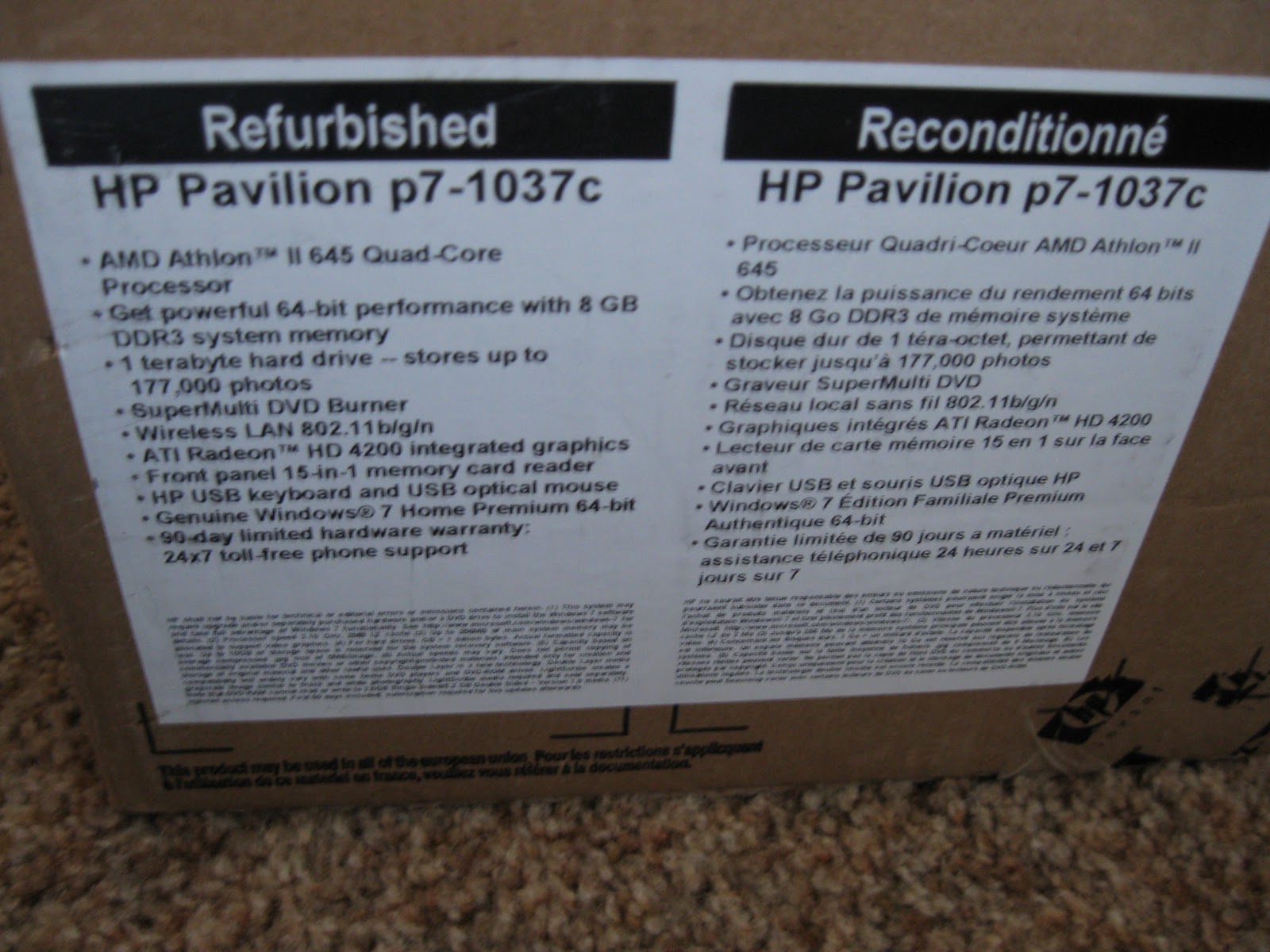
HP Pavilion p7-1037c and Buy.com


What is this? Why, it's a box.


 It's an HP box. (Hint, it belongs to me.) I woke up this morning to find that the computer I ordered from Buy.com on the 16th was already at my doorstep. After finishing walking the dog, I scurried back upstairs with my coffee and my extremely heavy box.

But what's this? I clearly remember ordering a p7-1057. WTF? I said, eyebrows furrowing. The specs seem to be exactly the same, but... hey, there's more ram! Best mistake ever.

That being said, despite quick service and having an unexpected upgrade, it's probably not good that they didn't send me the right computer. Well, I knew what I was getting into when I ordered from them, and this is probably the best mistake they could possibly make.

I have a rather profound love of box opening, thus why I took pictures. But the computer is kind of awesome. It was pretty cheap and has an AMD Athlon II 645 Quad-Core Processor, 8GB ram, 1TB hard drive, and an ATI Radeon HD 4200 integrated graphics. It can, by the way, actually run Fable III, even though it's at Very Low. (Yes, I'm updating the graphics card as soon as it arrives, whereupon it will be a GeForce GTX 260. Oh. Wait. Hey, UPS says it's at the door. BRB.)

Gawd damn it, why didn't I think to check the wattage requirements beforehand? Moreover, why weren't they anywhere on the specs? >:(

Anyway. I am in love with Windows 7 and this computer. It runs quietly and everything loads very quickly. The built-in wireless makes everything super convenient.

Now, if only the wattage was higher than 250w power supply when I need 550w for the graphics card, I would be overjoyed.

Sunday, October 2, 2011

DAO - 7 Hours In

Dragon Age: Origins. Yes. It's been a year, and we've finally come back to that. All of my objections from "3 Hours In" have pretty much been washed away as if they never existed.


Update: Battle

Since I last played, I have definitely managed to grasp the battle system. It's actually kind of interesting in some ways in many ways. Most WRPGs I've played are a solo journey. The player is the hero and has no comrades. Most JRPGs I've played are a journey with a party. Most strategy games involve a party, regardless of whether they're Western or Japanese.

Essentially, Dragon Age is a party-based WRPG, with a lot of strategy elements mixed in, which makes for a compelling system. Unlike with many other battle systems, I rarely feel disengaged or bored, as if I'm just clicking a button. For example, there was a party of Darkspawn who were guarding a bridge. My goal was to get to the other side of the bridge, but just hacking my way through was a failure-- I kept dying. So, to get through to my goal, I launched wave attacks. First, I went forward until they noticed me there and killed all who dared come close to my party. The leader of their band was still waiting, though, so we retreated and waited for everyone to rest and heal. Then, my character inched forward and shifted into stealth mode, getting out my bow and arrow and kicking some Darkspawn leader ass. The rest of my party rushed to join me and we pretty much rocked. Then, we retreated again, healed, and slaughtered the rest of the Darkspawn scum. There's strategy involved in how one wins the battles, aided along by the ability to switch between weapon sets with the stroke of a button, different skillsets for even characters that are both warriors/rogues/etc., and the ability to use one of my favorite techniques of coating my blade in poison. (Elder Scrolls or Dragon Age, it doesn't matter. Poison kills.)

Update: Story (and Writing)

The Human Noble origin story was predictable and a little boring because of it. Yeah, I said it. After that, it picked up and became more compelling, with a great deal of depth. Again and again, my character was confronted with the fact that she was a woman and a Grey Warden-- no one was entirely sure what to think of that, since so few women are in the Grey Wardens. They almost made too much of a deal of it, since there are plenty of women in the army-- and bonus points, Bioware, for saying that men and women are represented equally and actually representing them equally. (I'm looking at you, Fable III, who have female bandit uniforms but no female bandits.) But the repeated mentions of my sex actually make sense: the Grey Wardens are a bit of a boys' club. Though I need to walk a thin line between spoilers and actual discussion, I have to say that the culmination of the Joining was disturbing. The person who I had been sort of led to admire let me down with his actions, and people I liked had bad things happen to them. And this is pleasing, because it means there isn't only one-dimension to this story.

The Monsters Are Kickass

Look at these screenshots! Just look at 'em! Click on them to make them larger, so that you get the full depth of the experience. These guys are disgusting. They're scary. When they first appear on the screen, they're rushing in like the armies of Mordor. Countless hordes poured across the screen, heading straight toward Ostagar. I could feel the same fear that I saw reflected in the face of every man and woman in the game who saw what they were up against. I actually thought, "Oh shit, we're dead!" despite knowing that the game is a lot longer than seven hours. The only thing missing from these guys are worms and maggots crawling all over them, but maybe that would be asking too much. I hope not. I enjoyed being terrified of the people, the things, I was up against, enjoyed the fact that everyone I knew in-game was terrified of them. Because I could see why, I could feel it, and that was good writing. The only thing that could be better would be if this was twisted on me, if all of a sudden one of them spoke and had reasons. They don't have to be reasons I agree with, but reasons with their own interior logic. Something that I can understand and comprehend, even be sympathetic to, but which I'm going to have to kill them for anyway. And yes, I am waxing poetic over monsters. This is what Dragon Age brings me to.

Last Screenshot, I Swear


This woman. Morrigan. She is so cool and pwns everyone. I hope desperately (and actually rather suspect, since she has her own Codex entry) that she will reappear. Additionally, although I have no screenshot of him, Alistair is full of snark and I love him. Must go game now. I'll see you in Ferelden.

As a note: this is not an official review, as I am too in love with the game at the moment and have not played long enough yet to give it a decent review. Instead, consider it a play-through commentary, and part of a series of posts.

Friday, July 8, 2011

[Review] Fable III for PC

Oh, Fable III. Right now, I am very angry at it because it refuses to work on my desktop computer even though it will work on my sister's laptop. It causes a great amount of hatred to accumulate in my soul when things like that happen. Especially when no one answers me as to why this "Fable III Main Executable Error" keeps occurring. v_v

Let's ignore that for now.

For the sake of expediency, I'm pretending that Fable II didn't exist, since for PC players, it didn't. Jerks. To sum up before I even begin, Fable III is no where near as good as Fable: The Lost Chapters. It isn't challenging in the least, and isn't very interesting in general.

Story

The player is the Prince or Princess of the Kingdom of Albion. Your brother is evil and insane, and you have to wrest control of the kingdom from him by gathering followers throughout Albion. This is sometimes problematic, because your brother has damaged your reputation, and you have to regain the trust of the Kingdom of Albion.

Rating: 4/5

Battle


There are very few random battles while wandering the countryside. For quite a while, I was certain that there were none besides a few wolves, but then bandits finally appeared. When there is finally a battle, the hit and will points are completely invisible everywhere and virtually don't exist. These points direct health and magic, in case you're not familiar with Fable. I assume they're invisible because the character in Fable III doesn't have any and is both immortal and superpowered. I certainly have never had any problems with a diminished amount of either. Not having hit/will points makes it far too easy to just blitz out on the opponent.

I love the guns. I loved the bows in the original Fable, but the guns are easier to use all the time rather than just some of the time, though the lack of lock-on feature is occasionally annoying. Not super-annoying, however, and I got used to it quickly. Magic seems boring this time around, and it's a little bit hard to switch between types of weapons, since it requires the center button and scrolling, which means I tend to miss the button I want. A lot.

Rating: 2/5 

Quests

The quests are going to seem very familiar. What's this? A bandit camp? A missing child? A guard to traders? A cave of Hobbes? A rare book quest? The problem with this is that they aren't anywhere near as challenging as the first time around, even. The Hobbe cave is pretty easy where the last one was killer, though it's actually been a game high point so far; the missing child case involved a couple of attacks by a couple of wolf packs-- yes, wolves, not even balverines, and definitely no killer fairies; the trader got set on by a few bandits. There was never any tense situations in any of the quests. They were all just things I did rather than things I accomplished. There was no complexity, no missing child retrieved for a crochety granny with a BDSM cave guarded by a Demon Door in her backyard. And the Hobbe cave was too easy because the player has a companion during the entire thing to kill things for them. The most fun quest so far has been the gnomes, by far. A bunch of garden gnomes escape their collector, who is absolutely obsessed with them and brought them to life. THAT was what I was looking for. The first game was chock full of the kind of humor that spawns nasty, smart-talking garden gnomes. Fable III severely lacks it.

Rating: 1/5

Things That Fable III Is Missing

Things that are missing in Fable III? The ability to destroy your environment, since there is very little available to control. Guards that actually chase you down. The "eye" view that tells you when people are looking at you (though stealing is far too easy anyway). The fight clubs. Gambling. Female mercenaries/bandits, because since there is a female mercenary costume, there should be female mercenaries in the camp. Gay women; I saw several gay men, but no gay women. Demon Doors-- yes, there are a handful, but that's it: precisely one handful. Balverines. Monsters of pretty much any kind. Interesting quests. Interesting characters, even side characters whose names you never get, like that granny. Most importantly, the ability to really choose your morality.

In Fable III, I had a hard time finding times where I could make a consciously "bad" moral decision. I desperately wanted my Princess to turn evil after witnessing the death of the love of her life due to her brother. I couldn't. I wanted a bandit princess, but I was never given the option. The game sets you up against it because your brother is evil, and since you're against him, you're shoved into the role of a "good" character. The player character speaks, too, and is so earnest that it didn't seem in character for her to even make "bad" moral decisions, and occasionally those "bad" decisions aren't really "bad" at all. For example, there's a quest in Brightwall where the player gets sucked into a play. When I was cast as a Fool in the play, I could either tickle or kiss the king who ordered me to make him laugh. Kissing him has "bad" morality associated with it. Why? Both would provide laughter. Are we assuming that the player is male and that being gay is morally bad? I don't recall ever being told what the Fool is scripted to do in that situation, so I could hardly be going off script. (On that note, I could kiss a mercenary (*cough*bandit*cough*) in their camp when I was disguised as a male bandit for a quest. He proceeds to hurl for several minutes straight.) I desperately wanted to be a sneaky evil character. I was never allowed.

The Good Stuff
The graphics are nice. Such a paltry offering of "the good stuff," but there you have it. I like interacting with the townspeople and how the player can be friends with them, etc., though I would like it if they had more distinct personalities. I like questing to gather followers. I really like the guns. As in, I wish I could just carry a pistol and a rifle and leave everything else behind. The job mini-games are interesting, and would be more interesting if there was still some sort of gambling besides chicken races. As in, I want the card match game again. I like that Theresa has reappeared as the guide for the Road to Rule, in all of her red-clad Seer glory.

The Bad Stuff

I really don't like the new magic system and the lack of any sort of hit/will points. There aren't as many spells, either. ANGER! I want Demon Doors; they added a layer of depth. The lack of a Heroes' Guild completely removes the meta-quality of Fable: The Lost Chapters, making it a standard RPG rather than a funny, humorous, poking-fun-at-RPGs-yet-still-awesome RPG. I want there to be monsters. I want back the hard monsters, like Balverines, and Hobbes that come at you in hordes. I want the combat multiplier. I want the humor back, because Fable III just isn't very funny. I want the voice actor for my character done away with, so that I can decide what my character is like. Most of all, I want the morality aspect back. Fable III made me feel like I was being led into "good" decisions, and even though I wanted to make bad ones, I haven't yet even had the chance.

Why Play It?

I've been playing Fable III for 13~ hours. I obviously haven't finished the game yet, but I keep playing it. 1) Because I paid for it. 2) Because I am liking it somehow, despite finding it utterly subpar, largely because 3) I want so badly for it to be what it should be, even though it never is. If it gets better, I'll update this review, but as it stands, I am incredibly disappointed.

Fable III is a dumbed-down version of Fable: The Lost Chapters, right down to the same quests. Of all the things they should have kept-- and there were a lot of them-- they kept the one thing they shouldn't have. They kept the quests that I, the player, have done already, rather than the aspects of the game that I enjoyed, which they kept almost nothing of.

Overall Rating: 2/5


Review is continued, with some more in-depth (less angry) analysis, here.